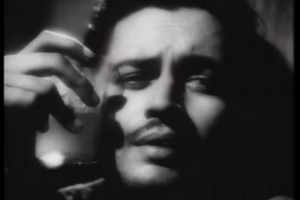


A hundred years have passed since the birth of Guru Dutt, and still, his films feel like letters we forgot to answer. In an industry that danced to easy rhythms of romance and spectacle, his cinema stood apart—quieter, heavier, filled with silences and shadows that refused to fade.
He did not give us heroes who conquered the world. He gave us men who lost themselves in it. Poets too fragile for fame, directors crushed by their own art, lovers separated not by villains but by the quiet cruelty of life itself.
Born in 1925 as Vasanth Kumar Shivashankar Padukone, his journey from Bangalore’s narrow streets to Bombay’s flickering studios was not a rise, but a restless search. Trained in dance, steeped in literature, and drawn to the broken corners of the world, he made films not for escape but for remembrance—as if trying to hold onto something already lost.
His early years in Bombay were filled with restlessness. He worked under Baburao Pai and Gyan Mukherjee, assisted in direction, acted in odd roles, and quietly studied the cinematic craft. In 1951, Dev Anand gave him his first break as a director with “Baazi,” a noir-tinged thriller where the streets were dark, the men morally torn, and the women far more complex than mere ornaments. With every film—”Jaal,” “Baaz,” “Aar Paar”—Guru Dutt dug deeper into themes of longing, loneliness, and the fragile spaces where art and life collide.
What set Guru Dutt apart from the clean, polished worlds of mainstream Hindi cinema was his attention to the spaces his characters inhabited. His films were full of objects—not the grand furniture of fantasy homes, but the ordinary things people live with: half-read books, broken mirrors, iron grills, faded curtains, dusty corners where forgotten letters might lie. These objects were not decoration. They were memory, absence, and longing made visible.
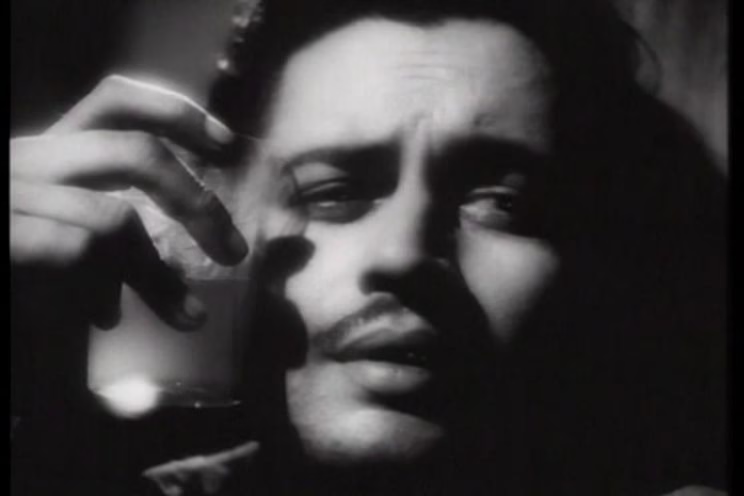
Working with cinematographer V. K. Murthy, he shaped light and shadow into something living. Shafts of light fell across deserted rooms, faces emerged from darkness, windows separated lovers from a world that did not understand them. Where most filmmakers cleared the frame for glamour, Guru Dutt filled it with the weight of life. Beauty, for him, was not about perfection—it was about truth.
In “Pyaasa” (1957), his most intimate film, a failed poet wanders the streets of a post-Independence city, misunderstood by family, rejected by publishers, and ignored by society. But beneath this plot, it was Guru Dutt’s own voice—longing for sincerity in a world busy selling dreams. The poet’s only refuge comes in the form of a woman who sees the worth of his words when no one else does. Their bond, fragile yet pure, stands quietly against a corrupt and indifferent world. The songs of “Pyaasa,” written by Sahir Ludhianvi and composed by S. D. Burman, became the soul of his cinema. When Mohammed Rafi sings “Yeh duniya agar mil bhi jaaye toh kya hai,” it is the cry of a man who finds no meaning in a world obsessed with success.
The songs of his films, written by poets like Sahir Ludhianvi and composed by S. D. Burman, became the soul of his cinema. Songs that didn’t just decorate the story but carried its heart. Melodies of rejection, love, and awakening that haunt Indian cinema to this day. “Jaane woh kaise log the jinke,” “Jinhe naaz hai Hind par,” “Chaudhvin ka chand ho,” — these were not mere interludes but the emotional lifeblood of his films.
And then, when he made “Kaagaz Ke Phool” (1959), his boldest, most autobiographical work, the story of a filmmaker discarded by his own industry, it was as if he could see the end of his journey. Fame fades, families fall apart, studios turn silent, and the applause dies away. The filmmaker, once celebrated, disappears into his own shadows. The audience of his time was not ready. The rejection devastated him. He never directed a film again.
Guru Dutt’s personal life carried the same weight. He married Geeta Roy, whose unforgettable voice gave soul to his finest songs. But what began in love turned into a home of silences and arguments. And then there was Waheeda Rehman, who entered his life first as an actress, but soon became his muse and perhaps something deeper. She saw his tenderness beneath the shadows. Theirs was not a relationship easily defined—not a public love affair, nor merely a professional bond. She described him as a man burdened by his own sensitivity, generous in his silences but distant when pain overwhelmed him. Guru Dutt, perhaps, loved too deeply to hold anyone lightly, and too restlessly to hold anyone for long.
Despite his personal isolation, Guru Dutt built a circle of close collaborators who trusted his vision. Writer Abrar Alvi, cinematographer V. K. Murthy, comedian Johnny Walker, and music director S. D. Burman—together they created a cinema that spoke to the human heart. Johnny Walker remembered how Guru Dutt treated comedy and tragedy with equal care—both, for him, were ways to survive a cruel world. Over late-night conversations, they built films that told of broken homes and unseen sorrows.
Guru Dutt was not simply a lonely man making personal films. He was an artist shaped—and broken—by his time. Post-independence India in the 1950s was a country caught between dreams of progress and the brutal realities of poverty, class, and social hypocrisy. The Bombay film industry, too, was changing. Studios became profit-driven machines. Art became product. The poet was no longer needed—only entertainers who could sell tickets.
Guru Dutt stood in the middle of this contradiction. On one side, his country was celebrating its freedom. On the other, millions still lived invisible lives in the shadows. While other filmmakers painted stories of patriotism and romance, Guru Dutt quietly asked: What happens to the individual soul in a society chasing material success? What is the worth of art in a world that doesn’t listen?
In his films, the poet is rejected not only by individuals but by the entire social structure—family, lovers, publishers, critics. He questions the price of fame, the emptiness of success, and the corruption of values in a “modernizing” India. The film studio—symbol of creativity—becomes a ghost town. The filmmaker, once celebrated, is discarded when he no longer delivers profit. Guru Dutt saw the film industry’s glamour as a mask hiding its cruelty.
His aesthetics also reflected his age. The crowded rooms, the dust-filled spaces, the iron grills and sharp shadows were not just style—they were the physical world of post-colonial Indian cities: growing fast, but leaving broken homes and forgotten people behind. Guru Dutt’s films are not just about personal heartbreak. They are about the heartbreak of a society losing its tenderness in the pursuit of modernity.
After his most personal failures, he produced a few more films, some commercially successful, but his inner light dimmed. He battled insomnia, depression, and addiction. Those close to him watched helplessly as he drifted further away, unreachable even to those who loved him most. On October 10, 1964, at the age of 39, Guru Dutt was found dead in his Bombay home. A mix of sleeping pills and alcohol silenced his voice, but his questions remain with us.
Today, in the forgotten corridors of Bombay’s old studios, or in a shaft of dusty light falling across an empty chair, Guru Dutt lingers. He did not belong to his time. Perhaps he does not belong to ours either. But somewhere between light and shadow, where beauty aches and meaning hides, his films still breathe. He was not merely a filmmaker. He was a man who filled his empty spaces with cinema, until there was almost nothing left of him outside the frame.
It is not easy to write about Guru Dutt without feeling the weight of all that was left unsaid in his short life. This piece is not a biography in the strict sense. Nor is it an attempt to explain his cinema—because perhaps some art is better left unexplained, felt rather than dissected. We wrote this on the occasion of his centenary year, not to celebrate him in the usual way, but to remember that a filmmaker like Guru Dutt still waits to be understood.
In a world that rushes past silences, he gave us characters who paused, doubted, and often broke apart. Maybe that is why his films remain. They remind us that beauty sometimes comes in broken forms, and that loneliness, when shared, becomes something almost tender.