

Lars von Trier’s Melancholia begins and ends with the end—both of the world and of the illusions we cling to. It’s a symphony of despair and cosmic indifference, a film that examines the inner devastation of the human spirit as it plays out against the vast, uncaring expanse of the universe. With its meticulous structure, haunting visual poetry, and piercing emotional depth, Melancholia transcends traditional cinematic boundaries to become a meditation on depression, artifice, and humanity’s place in the cosmos.
At its core, Melancholia is a portrait of two sisters, Justine (Kirsten Dunst) and Claire (Charlotte Gainsbourg), whose responses to impending apocalypse reveal divergent relationships with the world. Von Trier’s bifurcated structure—two chapters named after each sister—is essential. It mirrors the duality of human experience: despair and denial, the interior collapse and the desperate clinging to false stability.
The Mask of the Social World
The film’s first act, centered on Justine, unfolds during her wedding—a farcical façade of happiness that barely masks the corrosive truth beneath. Von Trier skewers the “fake social,” the endless posturing and empty rituals designed to enforce normalcy. The grotesque politeness of the event contrasts with Justine’s suffocating despair, her sense of disconnection. Her family, her colleagues, her new husband—all demand that she play a role: the perfect bride, the ambitious professional, the cheerful optimist. The wedding becomes a parody of human relationships, exposing their fragility under even mild pressure.
Kirsten Dunst’s performance anchors this critique. She imbues Justine with an ethereal detachment, as though she sees through the artifice of human life to its hollow core. Her moments of rebellion—breaking societal taboos with erratic behavior, sabotaging her career, and rejecting her husband—are not acts of defiance but symptoms of an internal truth she cannot suppress. Justine is a figure of pure melancholia, and in von Trier’s world, melancholia is an existential condition rather than a pathology.
The Universe as Indifferent Witness
The rogue planet Melancholia looms over the narrative, its approach indifferent to human trivialities. In von Trier’s hands, it is more than a celestial body—it is the film’s central metaphor. Melancholia represents not just the inevitability of death but the collapse of the self, the ultimate confrontation with one’s insignificance. While Justine finds solace in this void, Claire clings desperately to the illusions of safety and control, symbolized by her meticulously ordered family life.
Here, von Trier’s personal experiences with depression are palpable. For Justine, the planet’s collision brings peace. Her depression has already stripped away the delusions of meaning and permanence that Claire cannot let go of. In a hauntingly intimate scene, Justine lies naked under the light of Melancholia, as though communing with her annihilation. It’s a moment of brutal honesty, beautifully framed—melancholia as communion with the inevitable.
Von Trier’s Gaze: Cosmic and Human
Lars von Trier is a polarizing figure, often accused of misanthropy or theatrical provocation, but in Melancholia, his gaze is tender. He does not condemn his characters for their failures but shows them as fragile, complicated beings adrift in a meaningless cosmos. There is cruelty in his world, yes, but there is also empathy—a rare ability to see both the grandeur and absurdity of human existence.
The film’s visual language underscores this duality. The opening sequence—a slow-motion montage of dreamlike destruction set to Wagner’s Tristan und Isolde—is a masterstroke. Planets collide like dancers in an ethereal ballet, while Justine stands statuesque, carrying her veil like a spectral burden. These images convey emotions words cannot: sorrow, resignation, and awe in the face of annihilation. Von Trier’s framing transforms destruction into art, aligning him with Romantic notions of the sublime, where terror and beauty coexist.
Performances as Psychological Landscapes
The performances in Melancholia elevate its existential themes. Kirsten Dunst delivers what may be her career’s defining role, capturing the weightlessness of a soul unmoored. Her Justine is not merely depressed but luminous in her despair—her stillness conveys more than any dialogue could. Charlotte Gainsbourg, as Claire, is equally compelling, embodying the frantic anxiety of those who cling to life’s illusions. The interplay between the sisters is devastatingly real, their love tinged with mutual incomprehension.
Even the supporting cast—Kiefer Sutherland as Claire’s rational yet impotent husband, Stellan Skarsgård as a cartoonishly mercenary employer—serves to highlight the film’s themes. They are archetypes of a rational world that crumbles in the face of cosmic indifference.
Melancholia and the Masculine Eye
Von Trier’s masculine gaze is unmistakable, but here it feels less intrusive, more self-reflective. He uses the vastness of space not as a malevolent force but as a stage for the human psyche. Melancholia is neither punishment nor salvation—it is a neutral, uncaring phenomenon. If anything, von Trier’s own struggles with mental illness permeate the film, lending it authenticity rather than detachment.
An Ending of Unprecedented Intimacy
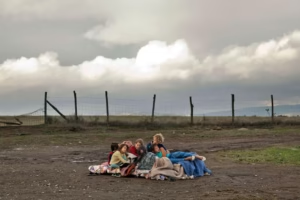
The final scene—Claire, Justine, and the child Leo huddled beneath the “magic cave” Justine constructs as the planet approaches—is profoundly intimate. The explosion is colossal, but von Trier focuses on the three figures, their hands clasped in an embrace. In this moment, humanity’s fragility becomes its greatest strength.
Von Trier leaves us not with hope but with the stark beauty of acceptance. Melancholia does not sentimentalize its apocalypse; it finds dignity in facing the void. The result is a film that, like the planet itself, hovers above us—a haunting, beautiful reminder of our cosmic insignificance.